Showing posts with label indigenous culture. Show all posts

Monday, February 9

Build trust and move ahead

    • Only 44% of the overall population believe that Indigenous people are open to sharing their culture with other Australians.
    • But 89% of Indigenous people say they are open to sharing their culture.


Reconciliation has a long way to go. The goodwill is there – but there's still an important problem. There's still too much misunderstanding and distrust between indigenous and non-indigenous Australians.

    • Only about 1 in 10 people feel there is a high level of trust in the relationship, with Indigenous people feeling this way about other Australians and other Australians about Indigenous people.

However, a survey released today shows many Australians would like more contact with Indigenous people. While just over half (58%) of Australians currently report contact with Indigenous people, more than three quarters (76%) say they would like contact in the future.

There is also a level of interest in helping disadvantaged Indigenous people, with more than a third of people (37%) expressing a wish to do so.

A critical finding is that only 20% of Australians say they know what they can do to help disadvantaged Indigenous people.

Overall, however, those of us who seek greater progress in reconcilation will be encouraged by the initial Australian Reconciliation Barometer, released today in time for Friday's first anniversary of the national apology to the stolen generations. Reconciliation Australia plans to repeat the survey every two years to measure progress.

Despite the misunderstandings and distrust indicated by the excerpts above (taken from the survey's Executive Summary), Indigenous and other Australians have much in common when they see themselves as family oriented, proud, good at sport, easy going, friendly, good humoured and welcoming.

Attitudes to one another differ more on values like co-operative, disciplined, hard working and respectful.

The Sydney Morning Herald's report this morning can be found here. As well as the executive summary, other sections of the Barometer report can be accessed through the Reconciliation Australia link above.

Of interest: The Australian's media section today says the National Indigenous Television Network has commissioned well-known human rights lawyer Geoffrey Robertson QC to run a new Hypothetical show. Closing the Gap. His panel will include Tony Abbott, Germaine Greer, Marcia Langton and "indigenous rapper Wire M.C." (perhaps one of you young fellas could tell me who he or she is).

It should be a lively show, to be broadcast on NITV this Friday, Feb 13 (anniversary of the Apology, remember!), at 8pm AESDT. as well as on some subscription and specialist channels. This report on the NITV website calls its broadcast an "exclusive premiere", so we city types without pay TV may get to see it later.

Thursday, November 27

I think it's English, but what does it say?

My day brightens when Google Blogger emails me: "[Someone] has left a new comment on your post [whatever it was]". It doesn't happen all that often.

So I snapped to attention this morning when I saw this in my Inbox:


smithsan has left a new comment on your post "Indigenous care for indigenous people":

A critical multicultural approach situates cultural differences within the wider nexus of power relations, and helps overcome the negative stereotyping that often prevents inclusive, self-determined care. Recommendations are suggested for change at the societal, professional and individual level.
-------------
smithsan
exposure marketing


I think it's English, but what does it say? It looks like the gibberish one has to regurgitate to score a PhD in, say, gender studies or Eng. Lit. or journalism.

Is someone having a go at me? In my post on indigenous care, I turned away from the term "cultural sensitivity" because I don't think abstractions win arguments, and there's one argument I do want to win.

I believe some white Australians still believe indigenous people are racially inferior. They'd deny it, or rationalise it away, if asked. But they still believe in paternalism, and in an intervention which fails to consult the indigenous people they believe they are helping.

In the previous post, I chose to use a number of concrete examples, brutally expressed, to explain why too many indigenous people now find themselves in an underclass. Not all Aboriginal people experienced every type of discrimination, of course, but many encountered some of those listed. That's too many.

And that's a major reason Aboriginal people are over-represented in poorer socio-economic groups.

I'm still puzzled by "smithsan" and the comment. Clicking on the name brings up a Google Blogger profile page, but it contains no profile. Unusual.

Clicking on the link provided suggests an answer. "Exposure marketing" takes you to http://www.drivenwide.com/. And what do we find? It's an internet marketing service, and clicking "what we do" in the navigation bar takes you to a page which says Driven Wide offers social media optimisation and marketing, search engine marketing and optimisation, and social marketing.

Sadly, this grumpy old blogger must concede it's unlikely his arguments have won the heart and mind of "smithsan", whoever or whatever that is.

It more likely "smithsan's" comment was computer-generated after a search engine picked up some key words in my post's labels, and its purpose was to publicise an internet marketing service.

It's interesting the program was able to find a passage like "critical multicultural approach" to post as a comment, but it just shows what computers can do these days.

For a long time, I've though of studying Search Engine Optimisation. Grumpy Old Journo sure could use it, and if ever I tried to return to the paid workforce, I could try for one of those high salaries SEO experts can obtain.

--ooOOoo--

I did appreciate some praise "Woy Woy Steve" attached to my October 27 post about the Putt Putt regatta. From his profile, it seems Steve may have attended Woy Woy High School (now the Brisbane Water Secondary College senior campus) at the same time as some of my offspring.

A self-taught web designer, Steve has put up a first-class website, http://www.woy-woy.com/. I found its local history pages well-researched and interesting.

And while you're looking at all things Woy, you may also be interested in a site offered by Spike. Here's one of his blogs .

Sunday, November 23

Indigenous care for indigenous people

It's been around our region for 21 years, but I'd never heard of Daramulen Home Care until the other day when Kirsty Bissaker came to our monthly Central Coast Reconciliation Group meeting to tell us about this specialist service for Aboriginal people.

Ms Bissaker, the acting service co-ordinator, explained that Daramulen's clients are mostly elderly, some are children with disabilities, and about 20 per cent are adults aged 25 to 40.

Staffed by indigenous people, Daramulen operates alongside the government organisation which provides home care in the wider community. But it offers more for its indigenous clients – help with housework, social get-togethers called “yarn-ups”, and the extra benefits which come from the carers' cultural sensitivity.

Impressive. So I asked Ms Bissaker: “If Kevin Rudd gave you some of this money he's splashing around, what would you spend it on? What's your biggest need?”

She didn't hesitate. “Medical transport.” With low incomes, without cars, and often living in areas poorly served by public transport, her clients face real hardship if, for example, they must get from their homes to a medical centre three times a week. Adding to the problems of disabilities and infirmity, some clients are illiterate and find it hard to access those services which do exist.

The following are my comments, not those of Ms Bissaker (although I hope she'd agree). Sometimes people ask me why we should provide special social services for indigenous people. Surely we're all Australians, and if we're in need there should be no discrimination.

You might assume the whitefellas who ask this question are rednecks, but often they are not, and they deserve a considered reply.

Cultural sensitivity? Well, that's true – but we're not going to win hearts and minds if we argue in abstractions. Here are the answers I give:


  • If you're fifty or over, and you went to the flicks in many country towns, you'll remember when indigenous customers sat up front on wooden benches.

  • Even if some of your playmates were Aboriginal kids from down the road, they'd often be barred from joining you in the swimming pool. That exclusion generally held firm until after the 1965 Freedom Ride through outback New South Wales.

  • In country towns in NSW, and probably elsewhere in Australia, whites had a “local option” to exclude indigenous pupils from government schools. For example, when European settlers in the Manning Valley finally pushed the indigenous owners off their land and resettled many of them on a mission, the good people of Taree asked the government to bar the children from their schools, and the government set up the Purfleet Aboriginal Provisional School. Up and down the coast, in towns like Kempsey, or inland, in towns like Walgett, the story was the same.

  • What would you say if your Dad came home from the war in 1945 and tried to put his name down for a soldier settler block, only to be told “abos” weren't eligible?

  • And try to imagine this. You're playing with your friends, when Mum starts shouting, “Git! Git! Git outta here fast.” As rehearsed, you run for the bush or down into the creek bed. You peek through the scrub, see a couple of cars pull up, and some whitefellas stride into your homes. When you creep back, your sister is gone. Your Mum and your aunties are inconsolable in their grief.

All of these things happened within my lifetime, and therefore within the lifetimes of some of Daramulen's clients.

It's no reflection on indigenous people to say such experiences turned too many into an underclass – people who cannot assert themselves at school interviews, or know how to dispute local council rulings, or negotiate their way through our complex and overstressed health system. People who may be functionally illiterate after rudimentary education in mission schools.

Today, one can see rapid improvement in the pride and achievement of Aboriginal Australians. And while most do appeciate the goodwill and efforts of whitefella friends, it's clear much of the credit should go to indigenous workers and organisations who understand the special needs of their people.

Tuesday, April 8

Kanyini – understanding Aboriginal culture

Photo of Aboriginal elder Bob Randall

You threw me a line called Welfare, but
it’s not as good as what I had … the
chaos and sadness we are feeling now
is a result of our history … Open truth
will set us free, not hidden truth.


Two worlds, two cultures. Perhaps there's no place in Australia where the gap is more brutally defined than Uluru. On one side, a luxury resort enjoyed by tourists from all around the world, and unseen on the other, a squalid township for traditional owners of the great rock.

If they do get a glimpse of Mutitjulu, the tourists may ask why the indigenous owners live like that. Surely they receive rents and fees from the tourists, as well as government welfare?

Perhaps some whitefellas begin to think indigenous equals inferior, that Aboriginal people lack the capacity to look after themselves or their children.

But listen to Bob Randall (pictured top), a respected elder, as he explains how dispossession has brought so much misery to his people:


Now we’re stuck between two cultures, two worlds; we can’t go back to the old ways because the natural environment has been destroyed. Nothing is there in its natural state anymore. We can’t get into your system because many of us don’t understand it. Hardly anyone has the skills to operate in your culture; they don’t have the education and reading skills to understand your ways and culture … so much money has been spent on an education system that isn’t working … it’s a failure. We need to consider new ways of teaching to incorporate old and new … so my mob can feel pride.
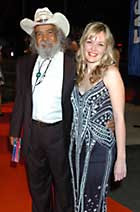

Pic of Bob Randall and Melanie HoganThe best way to listen to Uncle Bob is to view the film Kanyini, and to hear him explain the meaning of the word. In the Pitjantjatjara language of central Australia, it means connectedness – to a belief system, to spirituality, to land and to family.

It's a remarkable documentary. For its 53 minutes, it hit my emotional buttons so strongly I worried whether I could write a proper assessment. But here goes.

The early part of the film is almost a monologue as Bob Randall explains kanyini and the life Aboriginal people led before the whites arrived. He's direct, but almost genial, as he describes his people's culture. At times, he gently mocks whitefellas for their belief they have a superior culture and spirituality.

Cut into his talk are spectacular central Australian desert scenes, rich in vibrant colours, along with old black-and-white footage of naked Aboriginal men hunting, naked children romping in rockpools, mothers with children. And of Aboriginal people being taken away by whitefellas and put into whitefella clothes.

We begin to understand what the original Australians lost when the whites arrived, bringing the "benefits" of European civilisation.

Then a dramatic switch. Suddenly, the camera is taking us around Mutitjulu, confronting us with images of young people staggering as they inhale deeply from cans. We see dispirited adults mooching about, kicking at the dust and mud.

They are images we've seen only in recent years. Most Aboriginal communities refused entry permits to journalists, photographers and film-makers unless they submitted to censorship which deleted such scenes.

But the producer, director and editor of Kanyini is a remarkable young woman. Melanie Hogan (pictured with Randall as they collected one of the awards the film has won) graduated from the University of NSW with a first-class honours degree in economics, and joined Macquarie Bank – the "millionaires factory" – to work in corporate finance.

Then she dropped out, yielding to her creative urge to study film-making in New York and back in Sydney. Then, as she says:

. . it was only in April 2004 I realised I didn't have one indigenous friend . . . So I set off to the desert pretty much straight away, to learn all about Indigenous Australia – in a blackfella kinda way – through communication and relationship and following the direction of the wind.

At Mutitjulu, she was invited to produce a short film, Petrol Wiya, to combat petrol sniffing. From that, she teamed up with Bob Randall for the partnership which produced Kanyina, for which Randall was presenter and co-producer.

Trust me. Viewing Kanyina is a worthwhile experience, and the film would be an excellent resource for any group wishing to discuss indigenous culture. More information can be found here, including ways to order the DVD. The link to the study notes yields useful information for teachers and discussion groups.

In Kanyini, Bob Randall, born in 1934 of a Scottish station manager and an Aboriginal housemaid, tells of an idyllic childhood living in the camp away from the homestead. He was taken away as a youngster and never saw his mother again. As he says:

I was institutionalised because I didn't wear clothes or live in a house. In that natural way of living, there was no need for me to have anything other than what I had. It was not that I lacked love. As well as my biological connection, I had five mothers and six fathers.


Short biographies of Randall and Hogan can be read on the Kanyini website by following the links to "subject" and "director" respectively. The study guide is also worth, well, studying.

I had planned another leg to this post, but I'll keep it brief for now. Schools on the Woy Woy peninsula, where I live, and elsewhere are using Kanyini as an important part of a project called Yarn Up.

Yarn Up sums up its aims: Talk the Story, through viewing Kanyini and then discussing it; then Walk the Story as local Aboriginal people guide students over their traditional country, explaining how their people lived and related to their world.

It's a great concept, and I think it's going to work. Yarn Up tells its story here.