Showing posts with label Kanyini. Show all posts

Monday, May 11

Kanyini – a culture lost in dispossession

Photo of Aboriginal elder Bob Randall

You threw me a line called Welfare, but
it’s not as good as what I had … the
chaos and sadness we are feeling now
is a result of our history … Open truth
will set us free, not hidden truth.

Just over a year ago Grumpy Old Journo introduced a post (April 8: "Kanyini – understanding Aboriginal culture") with the image and the lines above. The post went on to say:

Bob Randall (pictured top), a respected elder . . . explains how dispossession has brought so much misery to his people:

Now we’re stuck between two cultures, two worlds; we can’t go back to the old ways because the natural environment has been destroyed. Nothing is there in its natural state anymore. We can’t get into your system because many of us don’t understand it. Hardly anyone has the skills to operate in your culture; they don’t have the education and reading skills to understand your ways and culture … so much money has been spent on an education system that isn’t working … it’s a failure. We need to consider new ways of teaching to incorporate old and new … so my mob can feel pride.
The best way to listen to Uncle Bob is to view the film Kanyini, and to hear him explain the meaning of the word. In the Pitjantjatjara language of central Australia, it means connectedness – to a belief system, to spirituality, to land and to family.

It's a remarkable documentary. For its 53 minutes, it hit my emotional buttons so strongly I worried whether I could write a proper assessment.

I've re-read that post a number of times, and I believe my comments were sound. Perhaps you'd care to read my critique, then make up your own mind by viewing the film.

Lane Cove Residents for Reconciliation has arranged a Sydney screening of Kanyini on Tuesday, June 2, in the Cove Room, Lane Cove Civic Centre, 48 Longueville Rd (cnr Epping Rd), Lane Cove.

The film's director, Melanie Hogan, will speak, along with Masada High School (St Ives) student participants in the Kanyini Schools Program.

The invite says 7.00 for 7.30pm-9.30pm. All Welcome - Refreshments - No Bookings Necessary - Admission Free.

.

Wednesday, December 10

Old and new, cultures meet in a schools festival

Photo of Aboriginal elder Bob Randall
Multiculturalism's big day in Woy Woy! It comes together next Tuesday at the Brisbane Water Secondary College senior campus (formerly Woy Woy High School), with three main components:


  • End-of-year reports and awards from the Yarn Up project, in which indigenous people people guide primary and secondary students from Woy Woy peninsula schools through their country, and explain the first Australians' relationship to it.

  • A visit by Uluru elder Uncle Bob Randall (pictured above) and filmmaker Melanie Hogan, producers of the film Kanyini, which was used to stimulate understanding and discussion at the start of the Yarn Up project.

  • Ten students and five teachers from Granville Boys High School – a school well endowed with ethnic cultures – will complete a two-day walk raising funds for prostate cancer research.

When I watched the 53 minutes of Kanyini last April, it hit my emotional buttons so strongly I feared my comments would be over the top. But I've just re-read my April 8 post, Kanyini – understanding Aboriginal culture, and I wouldn't change a word.

In a letter seeking sponsorships, Granville Boys High School captain and vice captain Berhan and Dean Kassem said:

Our school reputation in not good at the moment and we want to change this. This reputation is portrayed throughout the media and is not accurate. We know that this image is created by such a small number of students but it affects all of us.


To improve the image of our school and to let the community know that there are many great students at Granville Boys High School we have organised a WALK FOR CHARITY event.

At the Woy Woy school, the Granville boys will perform an Arabic drumming routine and a Pacific Island dance. You may learn more from their post on EverydayHero.

Here on our Woy Woy peninsula, Yarn Up is a worthwhile project, and I expect to learn on Tuesday just how successful it has been.

With plenty of activities, plus a sausage sizzle, the festivities begin at noon next Tuesday, December 16. I understand visitors will be welcome. If you'd like to come along, call Steve Collins at 02 4341 1899 or Jo MacGregor at 02 4341 1600 by this Friday, December 12. I'm told the best entrance will be from Greene St.

Tuesday, April 8

Kanyini – understanding Aboriginal culture

Photo of Aboriginal elder Bob Randall

You threw me a line called Welfare, but
it’s not as good as what I had … the
chaos and sadness we are feeling now
is a result of our history … Open truth
will set us free, not hidden truth.


Two worlds, two cultures. Perhaps there's no place in Australia where the gap is more brutally defined than Uluru. On one side, a luxury resort enjoyed by tourists from all around the world, and unseen on the other, a squalid township for traditional owners of the great rock.

If they do get a glimpse of Mutitjulu, the tourists may ask why the indigenous owners live like that. Surely they receive rents and fees from the tourists, as well as government welfare?

Perhaps some whitefellas begin to think indigenous equals inferior, that Aboriginal people lack the capacity to look after themselves or their children.

But listen to Bob Randall (pictured top), a respected elder, as he explains how dispossession has brought so much misery to his people:


Now we’re stuck between two cultures, two worlds; we can’t go back to the old ways because the natural environment has been destroyed. Nothing is there in its natural state anymore. We can’t get into your system because many of us don’t understand it. Hardly anyone has the skills to operate in your culture; they don’t have the education and reading skills to understand your ways and culture … so much money has been spent on an education system that isn’t working … it’s a failure. We need to consider new ways of teaching to incorporate old and new … so my mob can feel pride.


Pic of Bob Randall and Melanie HoganThe best way to listen to Uncle Bob is to view the film Kanyini, and to hear him explain the meaning of the word. In the Pitjantjatjara language of central Australia, it means connectedness – to a belief system, to spirituality, to land and to family.

It's a remarkable documentary. For its 53 minutes, it hit my emotional buttons so strongly I worried whether I could write a proper assessment. But here goes.

The early part of the film is almost a monologue as Bob Randall explains kanyini and the life Aboriginal people led before the whites arrived. He's direct, but almost genial, as he describes his people's culture. At times, he gently mocks whitefellas for their belief they have a superior culture and spirituality.

Cut into his talk are spectacular central Australian desert scenes, rich in vibrant colours, along with old black-and-white footage of naked Aboriginal men hunting, naked children romping in rockpools, mothers with children. And of Aboriginal people being taken away by whitefellas and put into whitefella clothes.

We begin to understand what the original Australians lost when the whites arrived, bringing the "benefits" of European civilisation.

Then a dramatic switch. Suddenly, the camera is taking us around Mutitjulu, confronting us with images of young people staggering as they inhale deeply from cans. We see dispirited adults mooching about, kicking at the dust and mud.

They are images we've seen only in recent years. Most Aboriginal communities refused entry permits to journalists, photographers and film-makers unless they submitted to censorship which deleted such scenes.

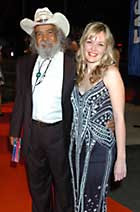
But the producer, director and editor of Kanyini is a remarkable young woman. Melanie Hogan (pictured with Randall as they collected one of the awards the film has won) graduated from the University of NSW with a first-class honours degree in economics, and joined Macquarie Bank – the "millionaires factory" – to work in corporate finance.

Then she dropped out, yielding to her creative urge to study film-making in New York and back in Sydney. Then, as she says:

. . it was only in April 2004 I realised I didn't have one indigenous friend . . . So I set off to the desert pretty much straight away, to learn all about Indigenous Australia – in a blackfella kinda way – through communication and relationship and following the direction of the wind.

At Mutitjulu, she was invited to produce a short film, Petrol Wiya, to combat petrol sniffing. From that, she teamed up with Bob Randall for the partnership which produced Kanyina, for which Randall was presenter and co-producer.

Trust me. Viewing Kanyina is a worthwhile experience, and the film would be an excellent resource for any group wishing to discuss indigenous culture. More information can be found here, including ways to order the DVD. The link to the study notes yields useful information for teachers and discussion groups.

In Kanyini, Bob Randall, born in 1934 of a Scottish station manager and an Aboriginal housemaid, tells of an idyllic childhood living in the camp away from the homestead. He was taken away as a youngster and never saw his mother again. As he says:

I was institutionalised because I didn't wear clothes or live in a house. In that natural way of living, there was no need for me to have anything other than what I had. It was not that I lacked love. As well as my biological connection, I had five mothers and six fathers.


Short biographies of Randall and Hogan can be read on the Kanyini website by following the links to "subject" and "director" respectively. The study guide is also worth, well, studying.

I had planned another leg to this post, but I'll keep it brief for now. Schools on the Woy Woy peninsula, where I live, and elsewhere are using Kanyini as an important part of a project called Yarn Up.

Yarn Up sums up its aims: Talk the Story, through viewing Kanyini and then discussing it; then Walk the Story as local Aboriginal people guide students over their traditional country, explaining how their people lived and related to their world.

It's a great concept, and I think it's going to work. Yarn Up tells its story here.

Thursday, March 27

The skills of persuasion

The following post won't make much sense unless you watch this YouTube video first:
http://www.youtube.com:80/watch?v=n7WJeqxuOfQ

Roy Beck is an articulate, long-standing opponent of any move by the United States to increase immigration. His views would appeal to many Australians, and the video, you should agree, is persuasive.

But before we allow ourselves to be persuaded, it's worth looking at how Beck emphasises his points.
  • Beck graphs population levels (the Y-axis) against years (the X-axis). He sets his baseline at a US population of 200 million, so the trendline rises steeply when population rises to 220 million. Start the Y-axis at zero population, and the rise would be almost imperceptible. It's not dishonest, but it can mislead an uneducated viewer.
  • The extrapolation of trendlines into the future is a hairy business at the best of times. Not much more than a century ago, some forecasters said streets would be knee-deep in horse manure as we tried to move all the extra people and their wares around our burgeoning cities.
  • Noddies. If, God forbid, you're a fan of TV current affairs shows, you've seen noddies. A producer goes back and films the interviewer nodding her head, then inserts the clips at appropriate points in the previously recorded interview. Beck focuses his camera on a succession of audience members as they nod thoughtfully.
  • Yet nowhere in the YouTube clip do you see Beck and his nodding audience at the same time. As he delivers his spiel, nothing in the vision shows he's talking to a live audience. Perhaps he is. You'll have to take it on faith.
  • You can't blame Beck for such professionalism, but his confident, articulate and forceful delivery may tend to distract people who should instead focus on the content of his address.

The gumballs demonstration at the end of the clip is clever, but is the US – or Australia, for that matter – really proposing to take millions upon millions more immigrants as an act of charity to relieve poverty and over-population in Third World countries. Really?

We can draw up many arguments about the appropriate levels of immigration, and where the migrants are to come from. I have my thoughts, and you have yours.

What we cannot deny is that immigration is vital for nations, such as Australia or the US, where the birthrate has fallen so far they are not replacing those who drop off the twig. Where will we find the nurses to staff our nursing homes?

In my next post, I expect to tell of Kanyini, a film about Aboriginal loss, and the way the film is being used in Yarn Up, a new schools project to help our children better understand Aboriginal life. Once again, I've paused to make sure any assessment goes further than my first emotional response. Please come back.