You will not be surprised to learn that Rupert Murdoch's initial ABC Boyer Lecture received a good run in The Australian and its sister paper, The Daily Telegraph, and in all the other capital city daily newspapers in the Murdoch empire.
The Oz had a short writeoff on Page One, a longer piece, Challenges Ahead for Australia, on P2, and the full text in the Media section. Photos showed Australia's business and cultural elites mingling at the Opera House where they turned out to hear the speech. The Terror ran him on most of P2 and the full text further in.
Nor will you be surprised that the Oz's lead editorial, headed “Frontier spirit in an age of freedom,” carried a sub-heading, “Boyer lecture was rich in insights born of experience.”
But what may surprise you is that your grumpy, left-leaning old blogger, a former long-time hack in the Evil Empire, found himself nodding agreement much of the time as Murdoch explained the themes he will develop in the six lectures.
Murdoch agreed that many Australians would question his right, as a man who became a US citizen in 1985, to judge the country, but said: “The main reason I agreed to come to Australia to deliver these lectures is that the country I see before me simply is not prepared for the challenges ahead.”
Many people remain suspicious of Murdoch. They cannot forgive his chumming up to Margaret Thatcher and the brutal move of his London newspapers to Wapping, his support for right-wing politicians and causes in the US, his failure to speak up for human rights in China. They see bias in his newspapers, and in his giving too much space to hard-right conservative commentators like Janet, Piers and Andrew.
There is some truth in all that, but not as much as most lefties contend. And I believe Murdoch has moved to what I shall call, for the want of a better term, the conservative left.
He remains a supporter of those values which conservatives hold dear – a stable society, free markets, the rule of law, property rights, individual responsibility, and offering public welfare money only to those in need.
But he departs from the conservative right – what I call the group-think of the Quadrant mob – in ways we lefties should applaud. He praises Australia's open, democratic and multi-racial society, supports reconciliation with our indigenous people, and advocates liberal immigration policies.
He pleads for reform of a “19th century education system” that leaves too many children behind, a system which “effectively writes off whole segments of Australians”, quoting both the social injustice it perpetuates and also the damage it does to Australia's ability to meet the challenges of the future.
Although he doesn't accept the wilder claims of many greenies – who could? – he does accept the probability of man-made climate change, and supports action now. He has instructed his own business empire to improve its environmental impacts.
As Murdoch clarifies his thoughts and expands on these themes for the Boyer lectures, he seems likely to distance himself further from Australia's hidebound conservatives. However, we can hope that because of who he is, as well as the persuasiveness of his arguments, he manages to take some of them at least some of the way with him.
Is it too much to hope that at least some of our lefties will put aside their prejudices, give him a hearing, and make up their own minds?
Monday, November 3


Alas, sub-editors can't hide their mistakes

Perhaps it's unwise to highlight the mishaps of other journalists, as Amanda Meade does in Talking Turkeys, a centrepiece of The Diary which she writes in The Australian's weekly Media section.
Today, they included “the wife of a 1980s corporate radar” to describe Janet Holmes a Court (from The West Australian's Weekend Magazine) and “not adverse to taking on political leaders” (The Age's Business Day).
Still, Ms Meade does have a reputation for reporting without fear or favour, even about her own newspaper – I seem to recall her being sidelined some years ago when she failed to carry out an instruction to remove an unfavourable reference to her employer – so no doubt Talking Turkeys next week will include the headline above, taken from the front page of The Oz's Business section this morning.
As News Limited's Style Book (the one I took with me when I retired five years ago) says:
“Pass: The past tense of the verb to pass is passed, not past.”
My red pen also hovered above “bogy”, but the Style Book rules – correctly, according to the Macquarie – it's “bogy” for the ghost, “bogie” for an undercarriage, and “bogey” in golf. And, if you're interested, it's Colonel Bogey.
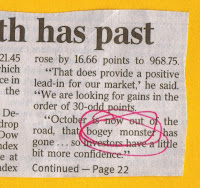
So the heading uses the correct spelling. Pity about the text, though.
To be honest, I don't get much of a laugh out of other journalists' errors. I've made too many myself.
Talking Turkeys works much better when it highlights the stilted or pretentious drivel which sometimes pops up in our media – or in the gushy handouts of public relations spruikers. That's the type of content which drives Pseuds Corner in British satirical magazine Private Eye, which may have inspired Talking Turkeys.
Today, they included “the wife of a 1980s corporate radar” to describe Janet Holmes a Court (from The West Australian's Weekend Magazine) and “not adverse to taking on political leaders” (The Age's Business Day).
Still, Ms Meade does have a reputation for reporting without fear or favour, even about her own newspaper – I seem to recall her being sidelined some years ago when she failed to carry out an instruction to remove an unfavourable reference to her employer – so no doubt Talking Turkeys next week will include the headline above, taken from the front page of The Oz's Business section this morning.
As News Limited's Style Book (the one I took with me when I retired five years ago) says:
“Pass: The past tense of the verb to pass is passed, not past.”
My red pen also hovered above “bogy”, but the Style Book rules – correctly, according to the Macquarie – it's “bogy” for the ghost, “bogie” for an undercarriage, and “bogey” in golf. And, if you're interested, it's Colonel Bogey.

So the heading uses the correct spelling. Pity about the text, though.
To be honest, I don't get much of a laugh out of other journalists' errors. I've made too many myself.
Talking Turkeys works much better when it highlights the stilted or pretentious drivel which sometimes pops up in our media – or in the gushy handouts of public relations spruikers. That's the type of content which drives Pseuds Corner in British satirical magazine Private Eye, which may have inspired Talking Turkeys.
Tuesday, October 28
Is the Federal Police commissioner a servant of the government in power?
On August 30, I put up a post headed “This time Mick Keelty must do the honourable thing and resign.” It was not without some misgivings – it's a harsh call, and the Federal Police Commissioner appears to be a decent fellow.
But as the Dr Haneef affair showed, he allowed himself to become a servant of John Howard's government in its duplicity and spin doctoring. Last night, ABC television's Four Corners program confirmed my view.
In my August post, I wrote:
When he won office in 1996, one of Howard's first actions was to sack six public service department heads – a third of the departmental secretaries – in a sudden and brutal putsch.
Many of us saw it as an assault on the public service obligation to give "frank and fearless" advice to ministers, although some might argue it was to ensure the public service implemented the will of an elected government.
But a police commissioner is not just a public service head. He or she has an obligation greater than implementing government policy – an obligation to uphold the law without fear or favour. When Howard bullied Keelty into a humiliating submission, and Keelty accepted it, they both destroyed something of value.
Last night, Four Corners revisited the humiliating "clarification" John Howard and his chief of staff Arthur Sinodinus forced Keelty to make in a televised press conference in March 2004. You will recall this came after the Federal Police Commissioner made an honest comment on Channel Nine which did not accord with the Howard government's spin on terrorism.
Chillingly, the Four Corners program showed that John Howard did believe the AFP was required to do whatever he demanded, provided it did not involve breaking laws.
In the course of a program titled Good Cop, Bad Cop – in which journalist Sally Neighbour investigated "what's wrong with the Federal Police" – Mr Sinodinus gave an interview on camera, and he is to be commended for his frankness.
Mr Sinodinus said the AFP's job was to "work within the framework of policy, subject of course to their not breaking the law".
Sally Neighbour came back at him: "Is it their job to do the bidding of government as long as it's not illegal?" Sinodinus replied: "In my view it is."
Think about this for a moment. Is it taking it too far to say John Howard and his chief of staff believed it was acceptable to sool the Federal Police on to targets which suited their political agenda? Providing, of course, it did not demand something which would be illegal.
Did Mick Keelty fail to dispute that view, especially after having submitted to the brutal public humiliation imposed by Howard and Sinodinus?
Perhaps, then, I was justified in this comment in August:
We now know there never was a persuasive case that Haneef was involved in terrorist activities or knew of the Glasgow bomb plot.
Yet Keelty oversaw the expenditure of more than $8 million in the investigation. He let the AFP become part of a political agenda driven by John Howard, Phillip Ruddock and Kevin Andrews. He did so at a time when the British authorities had accepted Haneef's innocence, and when our security services like ASIO had already ruled out Haneef as a terrorist concern.
The Four Corners program may be viewed online at
http://www.abc.net.au/4corners/content/2008/20081027_cops/interviews.htm
My August post should come up on
http://grumpyoldjourno.blogspot.com/2008/08/mick-keelty-must-do-honourable-thing.html
A correction: In my earlier post I said John Howard saw Keelty's TV interview and went ballistic. In last night's Four Corners program, Mr Sinodinos said he saw the program and phoned Howard to say there could be a problem. Howard's response was: "Ring Mick and let him know that I'm very concerned about this because of the way it could be interpreted."
Monday, October 27
A great day at the Putt Putt regatta – just the tonic to cheer me up
Not just a community carnival, but one for wooden boat enthusiasts – just what this blogger needed to lift his spirits. For the past week, I've pushed the unfolding economic news to the back of my mind as I focused on getting my pretty little boat ready for the show.
But for that distraction, I might have become depressed, not just at the risk of the worst global financial crisis since the Great Depression, but at the boring predictability of most of our bloggers and newspaper columnists. Yes, from both the left and the right.
And as for our politicians! Even allowing for the frustration at being in Opposition in times of national or global crisis, Malcolm Turnbull – the guy I still hope will remake the Liberal Party into something liberals could vote for – disappointed me with an unexpected shallowness, displaying more style than substance.
For a few days, I beavered away in the shed chiselling out and painting a nameplate for the transom, “Peter Pan”, and in smaller letters, “Woy Woy”. Once I would have paid a signwriter, but Merry has drawn shut the purse strings. Ah yes, it's millions of similar decisions which accelerate an economic hiccup into recession or even full-blown depression.
Still, it cheered me when a bystander at the the Lions Park launching ramp asked: “That's you, is it?” Right. Got it in one. Now I'm seventy, I can refuse to grow up.
At the ramp, we hoisted the sails – a standing lug mains'l and a little triangular mizzen out over the stern, both a rich brown tan – but with no breeze, we needed the little outboard to head across to the channel north around Rileys Island. With son Ben at the tiller, grandson Tim as crew and me as the proud old codger up front, we motored to the Davistown waterfront.
The annual Putt Putt regatta focuses on a marvellous part of Australia's heritage, the motor launches – most of them of traditional clinker construction – constructed in their hundreds by skilled boatbuilders all around the Australian coast, and powered by simple, robust motors.
Davistown is a fine site for this celebration. Tucked away on a creek running out of the Central Coast's Brisbane Water, it was the location of 19th and early 20th Century timber-getting and shipbuilding enterprises. Its name honours the Davis family, strongly involved in those early industries. Rock Davis operated a major wooden ship building yard across the water at Blackwall.
Peter Pan isn't a putt putt, so it's outside the main focus of the carnival. But it is a traditionally shaped wooden sailing dinghy (to a design by Hobart naval architect Murray Isles), albeit with a modern clinker ply and epoxy construction, so it did qualify as an entrant.
I had a great time yarning with other wooden boat enthusiasts, swapping and comparing information about designs and materials and suppliers. Joined the putt putt procession motoring up Paddys Channel, around Pelican Island and the oyster leases, and back through the Woy Woy channel and that narrow passage that divides St Huberts and Rileys Islands.
Mid-afternoon, when people were pulling their motor launches on to trailers, the wind had freshened. For the first time, we didn't need the outboard as we sailed back to the Woy Woy Lions Park ramp. A most enjoyable end to the day.
Let's leave it there. I may have some worthwhile ideas to put on this blog when I resolve some of those ideas I pushed to the back of my mind, but why spoil the mood today?

Saturday, October 18
Too hard to call?
Another update on The Australian's top-of-page strap heading across its news coverage of the economic crisis (see posts earlier this week).
Perhaps the Oz's editors have decided it's too hard to call between the "long slow crash of '08" and "the road to recovery". In today's Weekend Australia, the page of economic news reports carries no strap at all.
Perhaps Rupert Murdoch had a word with them. As Sydneysiders prepared their breakfasts this morning, their ABC news was carrying the first brief reports of his address to News Corporation's annual meeting in the US. Here are a few pars:
News Corporation chairman and chief executive Rupert Murdoch says the US could be heading into a prolonged economic downturn.
Mr Murdoch has told News Corporation's annual shareholder meeting the global financial crisis and a slowing US economy were already having an impact on the company. He said advertising revenue had fallen and the News Corporation share price had been beaten down.
Mr Murdoch expressed fears the US was about to enter a prolonged economic downturn, but stressed News Corporation was well positioned to weather the slowdown due to its $5 billion in cash reserves.
Meanwhile, Mr Murdoch continues to pour money into developing what is becoming the world's biggest integrated business and economic news empire. The big push began last year with his acquisition of The Wall Street Journal and its associated financial wire services.
Then he opened News Ltd's cheque book to poach the top financial journalists from The Australian Financial Review and other Fairfax papers. He didn't get them all, but enough came over to take his already talented team ahead of any competition. (Interesting to note that Fairfax management exempted the Fin from their "business improvement program", ie, staff redundancies and cost-cutting.)
Yesterday, the Oz launched the deal (note the trendy lower case), one of those glossy inserted business magazines designed for luxury goods advertisers, and it wasn't a bad effort at all.
The Business section of today's Weekend Australian launches a new business website which appears to be the equal of any I've seen. The site, www.theaustralian.com.au/business, is comprehensive, well organised and easily navigated.
The site is free, but one wonders whether the long-term aim is a service which will attract paid subscriptions. Mr Murdoch has been of two minds about charging for access to his online business newspapers.
When he bought The Wall Street Journal, he announced the highly regarded online edition at www.WSJ.com would become free, but soon changed his mind. Today, he told his shareholders that maintaining a "subscription wall" at WSJ.com was the best way to sustain revenue growth for the site. "Since it was acquired, WSJ.com's audience has surged 90 per cent," he said.
Access to much, but not all, of the Fin Review's online service, www.afr.com, requires a paid subscription. It's my guess Murdoch will keep his Australian business website free for as long as it gives a competitive advantage against the Fin, then will move to a paid subscription model with some limited free access.
In this article today, The Australian's editor-in-chief Chris Mitchell explains many of the features of the new website, and provides a link for even more details.
Oh, about top-of-page strap headings: The printed Australian newspaper's business section continues today with its own wording, "Global Financial Crisis".
Friday, October 17
Sorry folks, it's a Long Slow Crash after all
Has The Australian done a backflip? A few days ago, as noted in this blog, The Australian tried to mark the turning point for the economic and market crisis by switching the strap headline across its coverage from "The long slow crash of '08" to "The road to recovery".
Alas, share markets immediately nosedived again, United States data confirmed a recession, and signals firmed that one great hope for our economy, Chinese demand for our resources, appeared to be slowing.
So today, if you haven't noted it already, it's our solemn duty to inform you that the strap in today's Australian has reverted to the Long Slow Crash of 'o8.
Over on the Oz's high-powered Business section they just stayed with the more sober strap, "Global Financial Crisis".
Wednesday, October 15
Taking a positive view: Let's hope The Australian has it right

Perhaps many readers didn't notice, but today's Australian newspaper gave a significant endorsement to Prime Minister Kevin Rudd's emergency economic measures in particular and those of the world's governments in general.
Over the pages it devoted to the global credit crisis and sharemarket meltdown, it had been running a strap, THE LONG SLOW CRASH OF '08. It was still using it yesterday, as the clipping above shows. But this morning the Oz had changed the strap to ROAD TO RECOVERY.
Let's hope our national newspaper has it right -- that we really have turned on to the road to recovery. The alternative is too grim, because I believe we were headed for a worldwide depression to rival the 1930s.
For most of my working life, I covered financial and business news -- going right back to the nickel boom of the late 1960s. The collapse of the "entrepreneurs" in the eighties, Paul Keating's "recession we had to have," the excesses of the dot-com boom . . . you name it.
But since World War II, the world economy has never faced a threat of collapse as great as the current crisis, such a locking up of the flows of credit vital to economic activity.
And if, as seems likely, Australia really is showing the way forward, there'll be another benefit. We won't have to put up with the Poms sending out another Sir Otto Niemeyer to tell us it's far more important to pay the English bondholders than worry about the unemployed at home.
The Australian published good news roundups, probably the best of all our newspapers Down Under, and a good range of opinions.
But one could not avoid noting that all the conservative commentariat was singing from the same songbook, downloaded from the same old right-wing websites. It was all the Democrats' fault, and Bill Clinton's in particular, for forcing America's otherwise prudent banks to make all those sub-prime loans to people who couldn't repay them.
Initially, Janet Albrechtsen went right over the top. She became particularly enraged at Kevin Rudd's criticism of greedy bankers, even suggesting it was the distressed borrowers who were greedy. One wonders why she was so upset. Is there something she wasn't telling us?
Subscribe to:
Posts (Atom)
