Showing posts with label sub-editors. Show all posts

Sunday, May 24

Who needs sub-editors, anyway?

Squeezed by the recession and the internet, newspaper managements are desperate to slash costs. For many of them, the first fat to be trimmed came from editorial production departments.

What do all those sub-editors* do, anyway? The paper will still come out, and still look good, with half the subbing staff.

Well yes, but you may have to put up with this now and again:


– from the first paragraph of the Sydney Sun-Herald's
front-page lead this morning (in my edition, at least).


* Copy editors in America.

.

Monday, November 3

Alas, sub-editors can't hide their mistakes

newspaper heading shows spelling error

Perhaps it's unwise to highlight the mishaps of other journalists, as Amanda Meade does in Talking Turkeys, a centrepiece of The Diary which she writes in The Australian's weekly Media section.

Today, they included “the wife of a 1980s corporate radar” to describe Janet Holmes a Court (from The West Australian's Weekend Magazine) and “not adverse to taking on political leaders” (The Age's Business Day).

Still, Ms Meade does have a reputation for reporting without fear or favour, even about her own newspaper – I seem to recall her being sidelined some years ago when she failed to carry out an instruction to remove an unfavourable reference to her employer – so no doubt Talking Turkeys next week will include the headline above, taken from the front page of The Oz's Business section this morning.

As News Limited's Style Book (the one I took with me when I retired five years ago) says:

Pass: The past tense of the verb to pass is passed, not past.”

My red pen also hovered above “bogy”, but the Style Book rules – correctly, according to the Macquarie – it's “bogy” for the ghost, “bogie” for an undercarriage, and “bogey” in golf. And, if you're interested, it's Colonel Bogey.
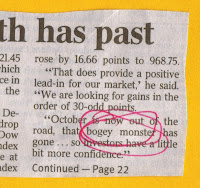
newspaper clipping shows misspelling of bogey

So the heading uses the correct spelling. Pity about the text, though.

To be honest, I don't get much of a laugh out of other journalists' errors. I've made too many myself.

Talking Turkeys works much better when it highlights the stilted or pretentious drivel which sometimes pops up in our media – or in the gushy handouts of public relations spruikers. That's the type of content which drives Pseuds Corner in British satirical magazine Private Eye, which may have inspired Talking Turkeys.

Monday, November 13

A grumpy old pedant, perhaps?


Following that terrible shark attack in Western Australia, I winced many times as news reports said the unfortunate surfer had lost his leg. The surfer, of course, lost a leg. Or, if it was the case, his right leg.

Pedantic? Possibly. But I remember myself more than forty years ago, a bright young fellow from Perth taking a place at the legendary horseshoe-shaped sub-editors table of Sir Frank Packer's Daily Telegraph in Sydney. I was in awe of the veteran subs sitting around the table, and with reason. If I'd let "lost his leg" through in copy, they would have mocked me mercilessly.

Another lesson quickly learned was to recognise passive voice and shoot it down. The Daily Telegraph of those days banned it totally, a ruling attributed to a former editor, Brian Penton. Today, I still dislike "Smith was hit by a runaway truck," preferring the active voice, "A runaway truck hit Smith."

Any sub-editor of my vintage would strike out "onto", making it two words (although an authority like Fowler's Modern English Usage does allow one word in some cases). The News Ltd style book that I half-inched when I retired says simply: "The style is two words, but only one is usually needed."

Yet I notice the Sydney Morning Herald invariably uses "onto" these days. Perhaps that august journal has adopted one word as style. And perhaps there's another explanation.

About a year ago, the SMH offered generous redundancy to its older journalists, and many accepted. When the older guys quit, did the newspaper lose those people who knew the difference between "onto" and "on to"? Perhaps a consistent grammatical style, once an important part of a newspaper's presentation, has become too expensive.

Usage does change, of course, and newspapers have to keep up. A few years ago, "e-mail" was common; today that hyphen has disappeared, although it's often still to be seen in e-commerce.

Nobody quibbles at "media" and "data" as singular nouns these days. "The media is to blame" and "the data has been released."

Later, perhaps, this blogsite may discuss the way newspapers reflect changing English usage, and even whether they still play their former role in setting public standards of literacy.